



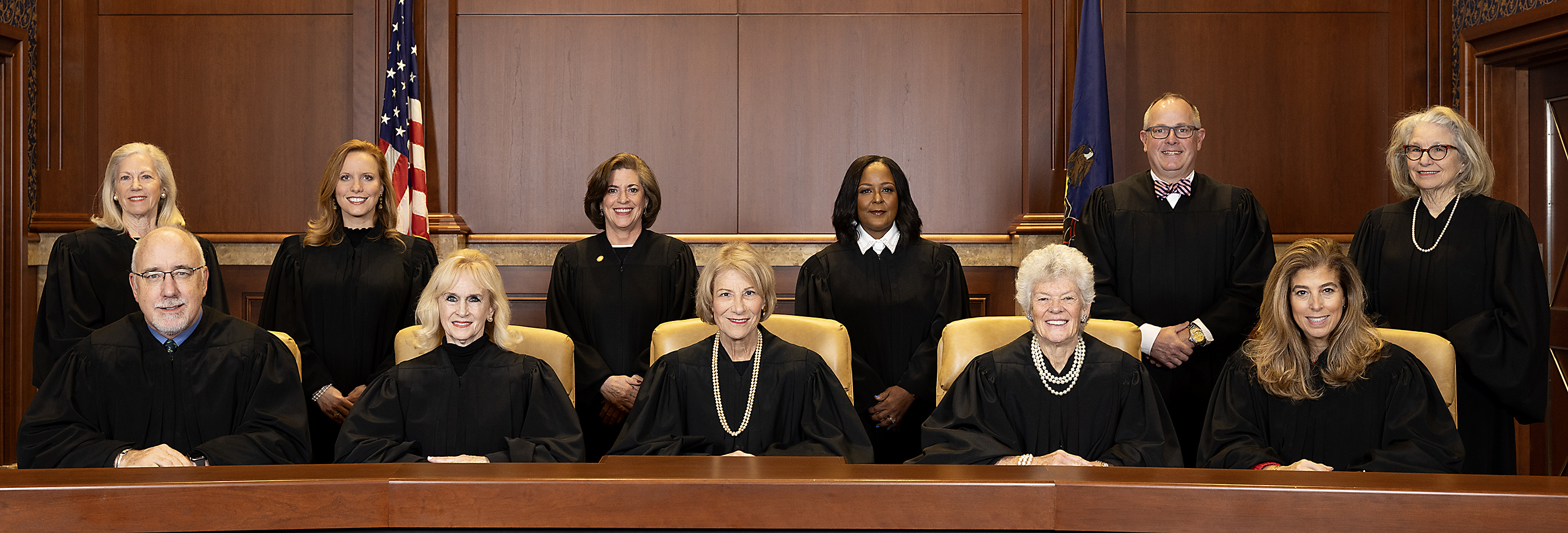
Commonwealth Court
Judges and Court Offices
Read Commonwealth Court judges' bios and access the Prothonotary's address.
Livestream Hearings and Arguments
To view the Court’s current Livestream Hearings and/or Arguments, please follow this link.
Doing Business with the Court
Copy and Fee Requirements
Certain filings with the Court require a fee that must be paid at the time of filing. Filing may be accomplished by filing a paper original and a specified number of copies in the Court’s filing office, or by electronic filing via the PACFile appellate court electronic filing system. All documents must comply with the general requirements of Pa. R.A.P. 124, but the specific requirements for how filing is accomplished and what must be submitted may differ depending on whether filing is done by paper or electronically.
Filing on Paper – See Pa. R.A.P. 121, which addresses filing and service of papers in general. All paper filings must be made in the Court’s filing office. Please provide an additional copy and a self-addressed postage paid envelope if you wish to have a file-stamped copy returned. All paper documents filed with the Court are scanned, and an electronic image of the document is maintained in the Court's Electronic Records Management System (ERMS). To facilitate scanning, Pa. R.A.P. 124 requires that the paper original must be unbound (but should be securely binder clipped); copies must be firmly bound. In addition to the required copies, parties filing paper documents are encouraged (but not required) to file an electronic copy of every paper document in PDF format on a disc, flash drive, or similar electronic medium. Follow the Copy and Fee Requirements link below for specific information on fees, the number of required copies of paper filings, and the system requirements for electronic copies of paper filings.
Filing Electronically via PACFile – See Pa. R.A.P. 125, which authorizes electronic filing through PACFile. Within seven days of submission of an electronically filed document, the filer must submit to the court a bound paper version of the electronic filing with as many bound copies as the court requires. To ensure that the paper version submitted is the same as the electronically filed document, the paper version should be a printed copy of the electronically file-stamped document that was returned to the filer after acceptance by PACFile. Follow the Copy and Fee Requirements link below for specific information on fees and the required paper version and copies of electronically filed documents.
Electronic Filing in Commonwealth Court - PACFile
Electronic filing is available in Commonwealth Court via the PACFile appellate court electronic filing system. PACFile is a service that provides attorneys and pro se litigants the option to file documents electronically on new and existing Commonwealth Court cases. Payment of any associated fees is also accepted at the time a filing is submitted and may be made with a Visa, MasterCard, Discover, American Express or ATM card. Upon the completion and payment of a filing, it will be transmitted to the court for processing. Registering for a secure user account is necessary in order to use this service. For more information about PACFile and to register for a user account, visit the UJS Web Portal.
Appealing a State Agency Decision – Petition for Review Forms and Instructions for Self-Represented Parties
If you wish to appeal a final decision of a state agency (for example, the Unemployment Compensation Board of Review, the Workers’ Compensation Appeal Board, or similar state administrative agency), you must start your appeal by filing a Petition for Review in the Commonwealth Court. The Court provides Petition for Review forms and instructions to assist self-represented parties file an appeal with the Court. Click the link below to be directed to the Court’s Petition for Review Forms and Instructions page.
When appealing an order of a state administrative agency or a trial court, the appealing party (Petitioner or Appellant) must file an appellate brief that sets forth the party’s legal arguments. Thereafter, the opposing party (Respondent or Appellee) must file a brief responding to the appealing party’s arguments. Filing an appellate brief is a mandatory part of the appellate process. In many cases, the Commonwealth Court’s resolution of the appeal will be based solely on the parties’ written legal arguments in their briefs; i.e., there will be no opportunity for oral argument. Therefore, it is very important to make sure all requirements for a complete brief are met. Filing a brief that does not substantially comply with the Pennsylvania Rules of Appellate Procedure may result in the appeal being dismissed or a party being precluded from filing a brief.
For detailed information on the requirements for filing a brief and what to include, review the linked Instructions for Preparing a Brief and the relevant Pennsylvania Rules of Appellate Procedure. All briefs must be filed in the Court’s filing office with the required number of copies, or electronically filed via PACFile (with the subsequent submission of the required paper version and copies). The following resources are available to assist filers in preparing and filing an appellate brief.
Election Court
The Commonwealth Court has jurisdiction to hear Petitions to Set Aside Nomination Petitions, Papers, and Certificates (Objection Petitions) related to the nomination petitions, papers, and certificates of candidates running for statewide and state-level offices. See 42 Pa.C.S. § 764. (Statewide and state-level offices include but are not limited to federal offices such as president, vice-president, senator, and representative in Congress; state offices having statewide authority such as governor; offices based on election district such as state legislative seats; and justices and judges of the appellate courts, the courts of common pleas and the Philadelphia Municipal Court. Candidates for statewide and state-level offices file their nomination petitions or papers with the Secretary of the Commonwealth.) Objections to nomination petitions, papers, or certificates that are originally filed with local county boards of elections must be filed in the court of common pleas having venue (NOT in the Commonwealth Court), and are not subject to the procedures discussed on this webpage. See 42 Pa.C.S. § 931.
Persons filing and responding to Objection Petitions should consult the relevant materials in the links below. In particular, all parties must be familiar with the Notice and Order, which provides important information about filing and service of Objection Petitions. In addition, those filing Objection Petitions must comply with the provisions of the Notice and Order directing use of a spreadsheet when raising objections to individual signature lines of nomination petitions/papers. The spreadsheet provided below may be downloaded for use in preparing and filing objections in accordance with the Notice and Order. Further, upon the filing of an Objection Petition, the Court will issue a Scheduling and Case Management Order. A sample of the Court’s Scheduling and Case Management Order is provided solely for the purpose of giving parties general information as to how the Court typically proceeds to resolve election matters in an expeditious manner. Finally, the link to the “Objection Petitions, Related Court Orders and Other Filings Page” directs parties to the webpage on which Objection Petitions are posted in accordance with the Notice and Order.
- ELECTION PROCEEDINGS - NOTICE AND ORDER (7/28/2026)
- ELECTION PROCEEDINGS - SPREADSHEET (REVISED 2/7/2025)
- ELECTION PROCEEDINGS - SAMPLE SCHEDULING AND CASE MANAGEMENT ORDER (REVISED 7/28/2026)
- ELECTION PROCEEDINGS - OBJECTION PETITIONS, RELATED COURT ORDERS AND OTHER FILINGS WEBPAGE (REVISIONS 7/28/26)
Americans with Disabilities Act Accommodation (ADA)
It is the policy of the Unified Judicial System (UJS) to prohibit discrimination against any individual with a disability, as defined by the Americans with Disabilities Act (“ADA”), 42 U.S.C. § 12131 et seq., in accessing or participating in judicial proceedings or other services, programs or activities of the Unified Judicial System.
Anyone who requires an auxiliary aid or service for effective communication, or a modification of policies or procedures to participate in a program, service or activity, should contact the ADA Coordinator or filing office to make a written request as soon as possible but no later than three days before the scheduled event.
Language Access
If you wish to request an interpreter for your case or need assistance obtaining information in your language about court services in the Commonwealth Court, please contact Brock Bevan at 717-231-3313.