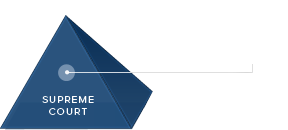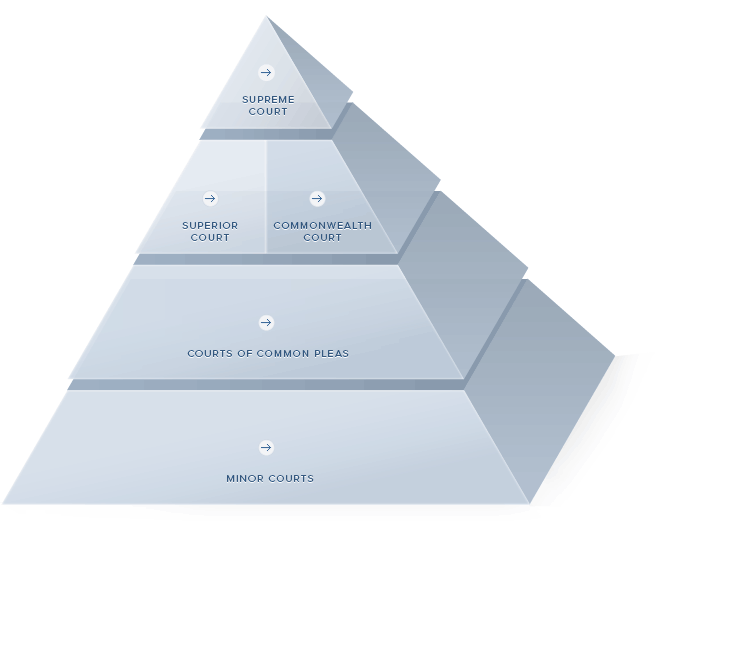
Dating to 1684, the Supreme Court is the highest court in the Commonwealth and the oldest appellate court in the nation. The Supreme Court’s administrative powers and jurisdictional responsibilities are vested with the seven-member court by the Pennsylvania State Constitution and a collection of statutes known as the Judicial Code. Administratively, the Courts within the Unified Judicial System are largely responsible for organizing their own staff and dockets, however the Supreme Court has several committees and boards responsible for writing and enforcing rules for Judges, attorneys, and litigants to ensure an efficient and fair judicial review.
Annually, the seven Justices receive over 3,000 requests for appellate review.
Most often,
but not exclusively,
the Court reviews:
Requests for Discretionary Appeals from the Commonwealth Court and Superior Court
Direct Appeals from a Lower Court’s decision, including when a sentence of death is issued
Requests to intervene in a Lower Court’s proceedings
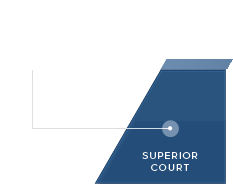
The Superior Court was established in 1895. It is one of Pennsylvania's two statewide intermediate appellate courts. The Superior Court is often the final arbiter of legal disputes. The Supreme Court may grant a petition to review a decision of the Superior Court, but most petitions are denied and the ruling of the Superior Court stands. Cases are usually heard by panels of three judges sitting in Philadelphia, Harrisburg or Pittsburgh, but may also be heard en banc by nine judges. The Superior Court often travels to locations throughout Pennsylvania to hear cases.
responsible for
Appeals in criminal and most civil cases from the Courts of Common Pleas
Appeals on matters involving children and families
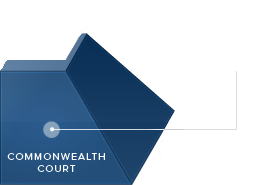
The Commonwealth Court was established in 1968 and is unique to Pennsylvania. It is one of Pennsylvania's two statewide intermediate appellate courts. The Commonwealth Court is primarily responsible for legal matters involving state and local governments and regulatory agencies. It also acts as a trial court when lawsuits are filed by or against the Commonwealth. Cases are generally heard by panels of three judges in Philadelphia, Harrisburg and Pittsburgh, although, on occasion, they may choose to hold court in other locations. Cases may also be heard by a single judge or by en banc panels of seven judges.
responsible for
Original civil actions brought by and against the Commonwealth
Appeals from decisions made by state agencies and the Courts of Common Pleas
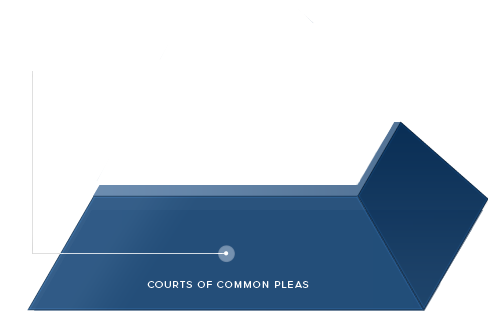
The Courts of Common Pleas are the general trial courts of Pennsylvania. They are organized into 60 judicial districts. Most districts follow the geographic boundaries of counties, but seven of the districts are comprised of two counties. Each district has from one to 93 judges and has a president judge and a court administrator.
Minor courts, or special courts, are the first level of Pennsylvania's judiciary. These courts are presided over by magisterial district judges (MDJs), municipal court judges and traffic court judges. MDJs and traffic court judges do not have to be lawyers, but they are required to pass a qualifying exam. Philadelphia Municipal Court judges do have to be lawyers. In Philadelphia, the minor courts are made up of a Municipal Court and Traffic Court. Each court has its own elected judges. In Allegheny County, the Pittsburgh Municipal Court is staffed by Allegheny County magisterial district judges and the complement is included in the total of 535 MDJs.
responsible for
Non-jury criminal and civil cases
Traffic cases
Whether serious criminal cases go to the Court of Common Pleas
Preliminary arraignments and preliminary hearings
Setting and accepting bail, except in murder or voluntary manslaughter cases